Enter the Cave
September 18, 2025
There were about six people standing in the line to enter the cave.
I heard the park ranger repeat the same words with the same tone in the same way to each of them. Never breaking character for a moment. Until we walked up and I was determined to talk to the person and not the uniform—
—
We were at Carlsbad Caverns National Park in New Mexico on a Friday morning in September. It was the day after my birthday. We left the morning before—at dawn— and drove across Oklahoma and Texas to the reef that once stood at the edge of an ancient sea. It's been buried for the past 265 million years. As the Guadalupe Mountains rose, sulfuric acid dissolved the limestone that formed the cave we were going into around 5 million years ago.
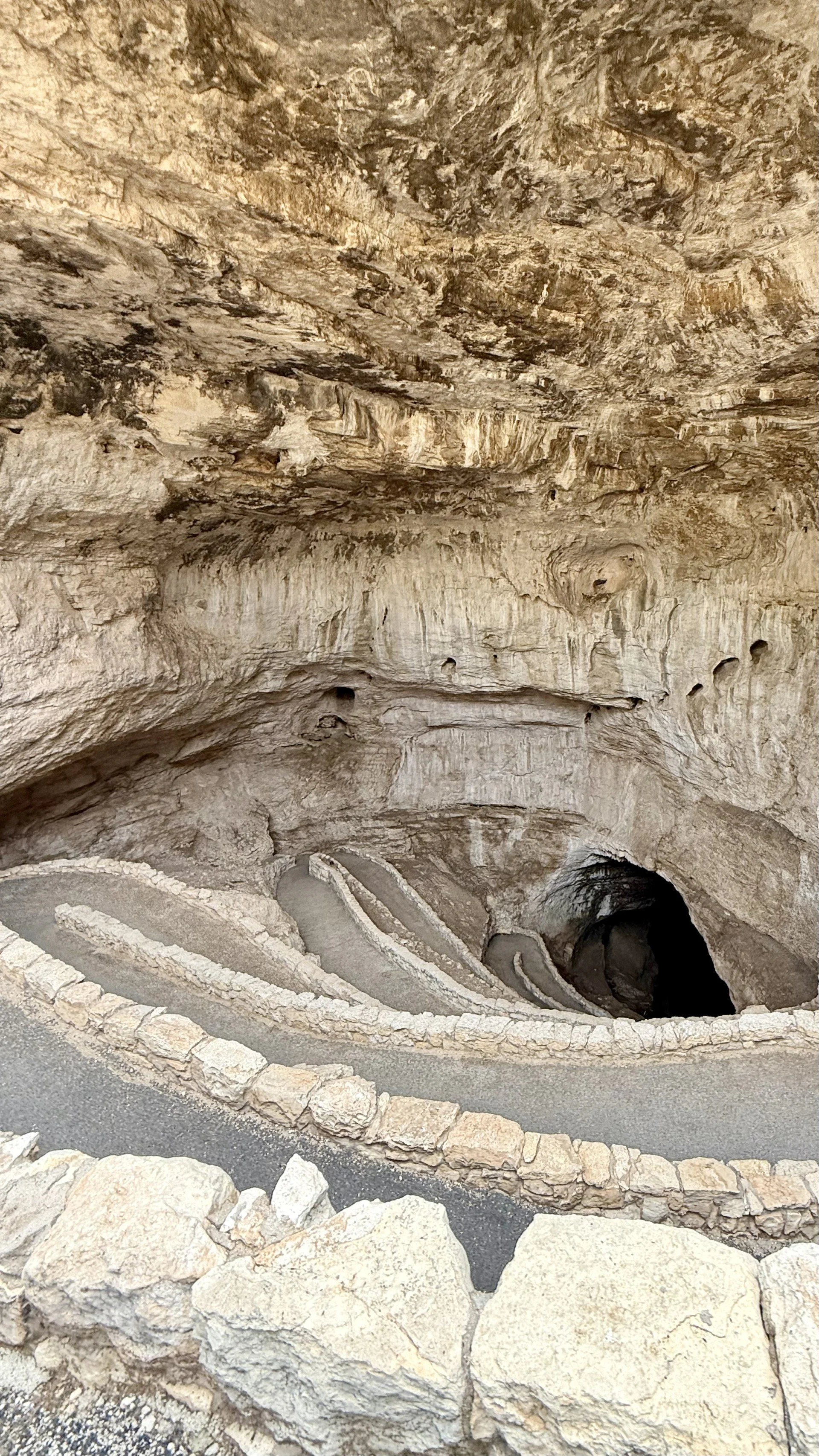
To enter the cave, you descend 750 feet, winding back and forth through 60 or more switchbacks. Traveling deeper and deeper, but never into complete darkness. The walk is well lit with electric lights and the rooms are even brighter. It feels unnatural being so far beneath the surface with light shining so close. It wasn't until the furthest point in the cave that I felt that feeling you get when you are deep underground. It’s exactly like when the walls are closing in around you and you can't see the door anymore.
The entire time you are surrounded by ancient formations that are only there because of the slow and steady drip of water, acid, and time— everything around you makes you feel small and young in your years.
We walked and walked deeper into the earth. At one point, we heard a young girl say that she never wanted to come back. It was so much walking and so far away from the sun. She didn't like it at all.
I can’t say I blamed her. I felt far from the sun and sky as well.
And where were we walking to? All around the cave with our end destination being: the elevator. Traveling to this depth takes time, but don’t worry, once you make it to the end, you’ll be back to the surface in mere seconds.
In a cave, the trail is usually permanently determined by those who came before. If you side track, you risk destroying it. Caves are very special places. A portal into the very earth from which we came. They are sacred.
A few hundred thousand people walk these same steps every year with very little variation. Everyone takes their pictures which will never look like the actual thing in comparison. Still, it is something to remind you that you were here for the briefest of moments. You will never forget the cave, however, the cave is certain to forget you.
It is very quiet. Everyone speaks in whispers because all sound is magnified. I can only think to describe it as feeling very soft. You hear amazement constantly. Awe. People reacting in real time to a phenomena that is so beautiful and incomprehensible.
Near the elevator at the end of the trail, there is another relic of a time long gone. A cafeteria— a place where families would stop and eat —simply for the sake of being there—before shooting off again for the surface like a rocket to the moon.
Back into daylight. Back to everything you left behind when you stepped down into the cave— out of sight and out of service and into the present moment. It'll hit you dead in the center if you're not looking out for it. Text messages. Emails. Work obligations. Family. Pets. All of it that was outside the cave when you went inside.
We were in it from 10:13 am to 12:43 pm. A precious way to stop time.
The minutes after seeing something you've never seen before are some of my absolute favorites to live. I love to sit and relish in an immediate memory. Think about what it means. Think about how the place connects us to something across space and time. This is the moment for reflection. Contemplation. Meditation.
To stop and stare into the bottomless pit—To defy darkness with light—
And then— the stalagmites and stalactites. Only a few more millions years until they can finally touch. Can you imagine? The patience. Waiting that long for destiny. Drip by drip. Moving at the speed of a chemical reaction reacting. Compared to our own brief lifeline, it is infinity.
—
I don't remember the park ranger’s name. But when he said "y'all" when asking us about our tickets, I knew he had deviated from the script. We were seeing him. And that was when I asked him about the first time he saw the bats leaving the cave.
—
You might not know this but in addition to the half a million tourists and travelers, cave enthusiasts, reluctant teenagers, retirees, young children, and everyone of all ages in between and beyond, there are around half a million Brazilian (or Mexican, depending on who you ask) Free-Tailed Bats that live for months at a time in the same cave you walk through. They hang suspended in darkness waiting for their bodies, wound like a clock, to come out at just the right time— sunset.
We took our seats at 5:53 pm along with everybody else from places unknown. We were all gathered there to see the bats emerge. To take flight into the night and travel up to 25 miles hunting insects and nectar in the nearby river valleys.
There is a silent signal they ask you to give when the bats begin. This is important. Excessive noise stops them from coming, so nonverbal cues are essential to communicate in this critical moment. And the signal— you raise your hand and spin— just like a tornado— and that's exactly what they looked like. Hundreds at a time. Hundreds of thousands over the full duration. Spinning— topsy turvy— distributing and redistributing their weight to gain lift. A bat does not fly directly into the air, they must fall first using gravity to find momentum.
And then they fly into the twilight. The multitude. Like a river flowing away from you.
At the right time of year, they pollinate the agave blooming. So without this moment, basically, there would be no tequila.
Meanwhile, a great horned owl sits. Perched above the mouth of the cave. Full of knowing about what happens here at sunset. Like us, the owl watches the bats spinning— swooping silently— and at just the right time— we heard contact.
Out of around half a million bats, there was now one less.
—
We sat and watched well beyond our ability to see the bats, but we could hear them. Their wings flittering. Occasionally chittering. High pitched squeaking.
We walked back to the car and I could feel it—amazement.
It was completely dark outside. We drove for a few miles to an overlook. And there in the great expanse of a desert there were lights shining.
In this same location, at the edge of the Permian Basin, is one of the most prolific oil and gas producing areas in the world. It puts the United States on the map for oil production. The scene looks exactly like what it fuels, a machine toiling. Because of this before me, I could see the bats emerge in less than a day's drive from Arkansas.
—
Actually, I met someone somewhere sometime who worked out there for a couple of years. He said they run shifts there around the clock. A reminder that in today's world there are fewer and fewer times in the day, if any, where profit does not motivate. Here the clock never stops pulling resources beneath the earth so that we can keep going.
So that I can drive my car, use my plastic pen, and write to you this message that will take even more labor from those men and women unearthing millions of years of time in the making.
But God, sitting with those bats emerging from darkness… it was everything.
—
The park ranger told us his story as he handed us the tickets—
"My first time?" he said, "It was my job to stand at the top and stop anyone from taking pictures or using their phones as the bats came out. It’s important, you know, so you don’t bother them. So I was watching everything pretty closely. But when the bats started to come out, I couldn't help myself. I had to leave. I went to the bathroom, shut the door, and started sobbing uncontrollably."
I understood exactly what he meant.
And it makes sense. Scientifically, there is actually an explanation. Bats use echolocation. A biological sonar system where they emit high-pitched sounds and listen for the echoes that return after bumping into nearby objects. The echoes give them information and we were the objects.
Every individual person there became a wave— a vibration—
Do you ever stop to wonder what your echo sounds like? Perhaps now is a good time.
—
For me, I cried too.
I have never felt so seen before.
And it only took half a million bats flying by.
