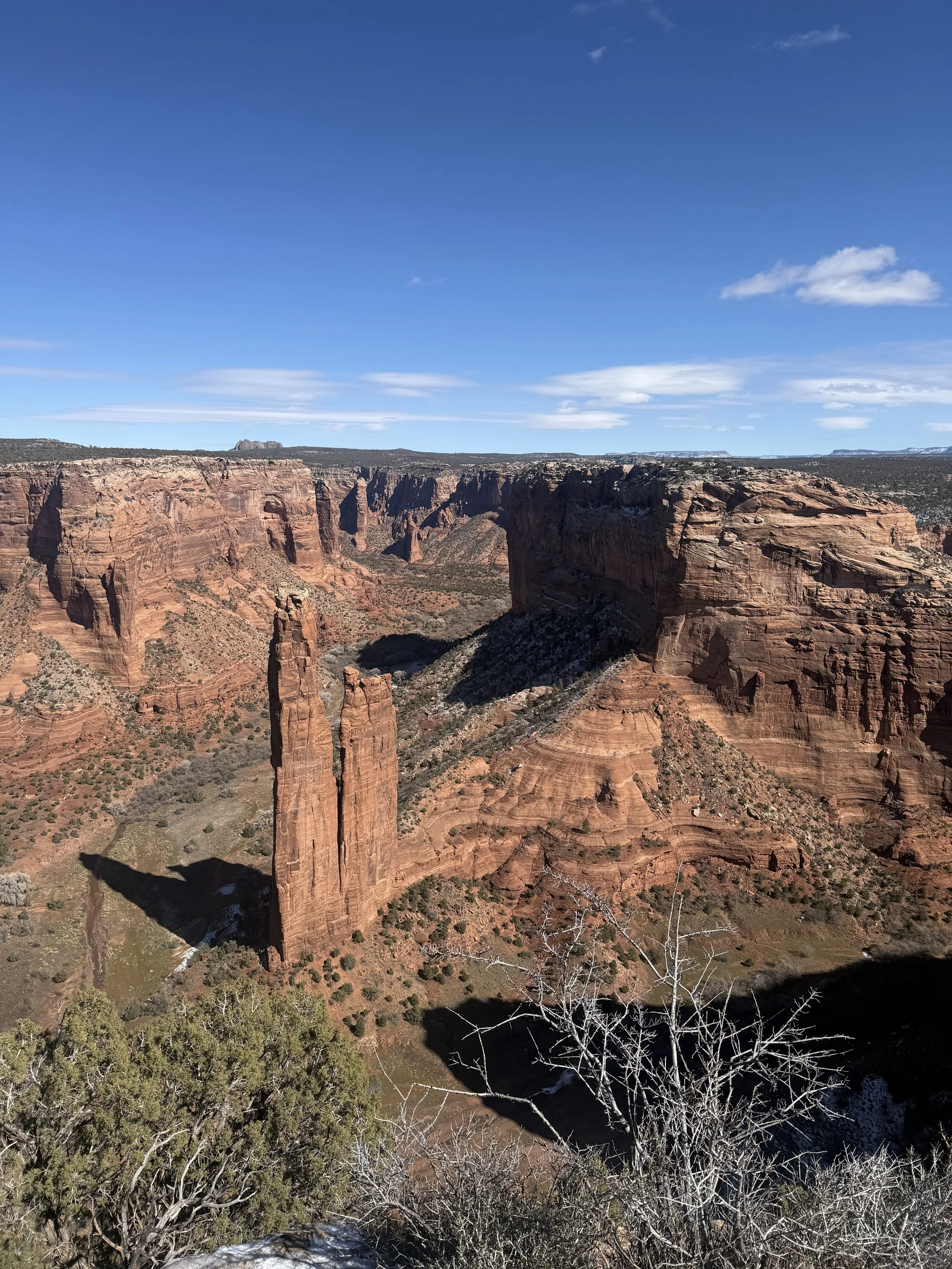
Sometime in February…
I made a few questionable choices when I went on this particular trip. I didn't have a plan. All I had was a destination.
Somewhere where someone told me to go—
To see.
That is what he told me.
I left on a Monday. The best day for traveling in my opinion. All the weekend warriors are back to their desks and into their beds and the campgrounds are empty. Of course, no one really wants to go camping in February anyways. But that's exactly the reason why I was going.
Let's go back for a moment to May 2024. That's where this started. I was passing through Four Corners and stopped to exchange all my cash for things made by the people who live there. This is something I always do. There was a Hopi man there who I talked to for quite awhile. He showed me his paintings and the art form that had been passed down in his family for generations. He told me he could see I was different. "You are a funny white lady," he said after we had been talking for awhile. "You were walking so slowly. One day you must go to Canyon de Chelly. There you will see something of what you are seeking."
—
So here we are on this Monday morning in February 2026, as I set out on this journey. My first stop would be in Oklahoma. I wanted to find a buffalo and paint. I was in the Wichita Mountains near Medicine Park driving through the wildlife refuge when I saw one grazing alone on a hill not far away from a turnout off the road. The herd is about 600 now. It started with 15 bison from the Bronx Zoo in New York City to help restore the population in 1907.
There was a little trail heading in that direction so I followed it with my canvas and paint. The task felt really simple in my mind until I began approaching the animal in all of its size and strength. It could crush me and I am not a fast runner.
I walked slowly and set up where I felt it was a safe distance. Nothing prepared me though for the moment when I set up my easel and we locked eyes. This enormous animal. Absorbing my face and my feeling. Both of us trying to decide if we were safe to stay in that space near each other. Suddenly, I realized, in a way, that we were both prey.
I calmed my breath and let my body soften and relax all over. "I am no threat to you," I kept thinking. "I love you." And I felt my eyes show it to the bison. And in return, I could see those deep, brown eyes—with the sunlight shining—like honey—sweet and dripping— perfectly formed— instinctually searching.
The bison began grazing again and I knew we were both okay. We both felt safe. So, I painted.
Time passed and eventually I got up and left. The bison was still grazing and a few more were starting to walk in from down the hill. Walking away, I felt much heavier and slower than before I walked in. And I was happier too.
—
I watched the sun setting on top of Mount Scott which is an absolute must see if you are ever southwest of Oklahoma City off Interstate 44 near Medicine Park. You can stand and look for miles in every direction. It’s hard to find a proper place to do that sometimes. Usually it is windy and that time it was no different. It was windy and cold. I pushed the front seat back in my car, opened the windows, and pulled my painting into my lap to watch the sun fade away into the horizon. I painted until I couldn’t see colors anymore.
I didn't know it at the time, but just a few days later I would meet a woman painting in her car at the edge of the earth too. And she would tell me a secret that I should give to no one. I carry it to this day.
—
I left Oklahoma the next morning to drive nine hours towards White Sands National Park in New Mexico. Like I said, I had a destination, not a plan. It was just before sunset when I arrived. Perfect timing. I hadn't eaten anything yet that day so I tore off a chunk of bread I had baked and cut into an avocado. Dinner was made.
Then I wandered around the white sands looking at the sunset. Listening to the birds that find a way to live and sing in what seems to be an otherwise bleak environment. Still, I noticed, they find a way to sing.
I walked around until the stars began to appear in the eastern sky over the mountains at Cloudcroft. It was time to find camp and I thought I knew where I was going to rest my head.
Honestly after all these miles of wandering through different campgrounds and parks, I had never seen a campground with a gate and a spike strip forbidding anyone to enter after dark. And when I arrived, it was in fact after dark. It was late and I was exhausted.
I didn't have a backup plan so my options were drive back a couple of hours to another spot where I knew for sure I could camp or head into town and stay at a hotel. I took the easy route and drove into town where there was a lesson coming for me.
Someone told me one time that it is okay to be a wanderer, so long as I wander with purpose. I come back to this a lot when I feel lost within myself. Next time around, I've already decided. I'm going to be a tree and cease all this wandering. I knew where I was supposed to be on my way to Canyon de Chelly, but for some reason I was way down south in New Mexico without a place to stay— I'd call that a little aimless wandering.
I don’t know why but that night I couldn’t sleep. I didn't feel safe even with four solid walls and a locked door around me. I was having a nightmare. Every time I woke up and feel back asleep, I was back in it. I couldn't stand it. It made me feel all kinds of feelings.
—
I took off around 3 AM. A complete waste of money. I felt like I was about to give up on myself and on this trip. I was going to end this pointless journey and head back. There was nothing out here to see and I probably I should have been at home. I started driving back east.
A couple hundred miles later, the sun was beginning to rise. I pulled over at the Valley of Fires to make a cup of coffee and slow down. It is just west of Carrizozo, New Mexico. There is a little piece of land entirely surrounded by lava rock. It is an island. Perfect for deep thinking.
I've noticed on social media and by interacting with people that there is a lot of attachment to certain rituals that sell an idea of enlightenment. We are made to believe that yoga only happens on a mat. Cold plunges happen at the cost of electricty. Meditation happens because you sat on the ground with your eyes closed. And don't forget, the body must look perfectly Instagram worthy. A matching set to complete the look. But these are not ways to become closer to God— to yourself— to love. Keep following what speaks to you as you walk your path of truth. Be exactly who you are, as you are, and honor that perfection which has been given to you. If people don't understand that part of you, let them stay confused. They are not meant for you.
I watched the light growing that morning and I kept thinking about the conversation I had with the Hopi man.
"Go to Canyon de Chelly," he said, "and you will find something along the path that you are seeking."
It just seemed crazy to me to follow these words, but I kept coming back to it. I had to go there, even if I didn't understand why. Even if it felt like a complete waste of time.
As the sun filled the valley all around me, I got out my atlas and took a look at the road that would take me there.
That day I can honestly say that I enjoyed myself. I took all the old highways. Got obliterated by some more wind. I drove through the mountains in a snowstorm gripping the wheel so tightly—wondering what I would do in this particular middle of nowhere if I went off the road. I laughed. I cried. I was terrified. But I was fine. I made it to Chinle, Arizona without any problems and I found a place to stay in a Navajo hogan for a few days just as another wave of snow began to fall.
—
The next morning I woke up slowly. Three dogs were waiting outside my door sleeping in the sunshine. They took me on a walk. We went along the mesa all the way to the edge where it overlooked the canyon and the road that would take me into town. That day I just went for a drive learning about the place where I was and how to get to Canyon de Chelly from where I was staying.
I went to eat at Junction Restaurant. It was recommended to me by my host. He pointed over to the east and said, that is where my father's family is from. Over there in the mountains. And he asked me where my family is from, so I told him about Southern Illinois.
I was the one and only person with white skin and blue eyes for dinner that day. They sat me way back in the corner away from everyone. I smiled at the children who kept staring at me from the next table over. No one else really looked at me. It was okay though. I understood why. Tourists are their own certain kind of people. I recommend never becoming one.
I went back every day I was there and eventually I made more eye contact with a few people looking at the dusty girl in the corner with dirty hair eating alone. I would smile. I suppose they knew I wasn't just another person coming to look and take pictures and pass through. Although what I was seeking exactly, I still hardly knew.
On the second day there, I drove to Spider Rock Canyon Overlook where they say Spider Woman still dwells to this day. She is who taught the people about weaving—wisdom— protection— and devotion.
I sat there and looked for a long time into the canyon listening to the silence and the wind. The occasional horse neighing from the distance below. I could see a small herd of sheep. And a hogan with a fire burning.
I met someone there on the edge of the cliff and started a long conversation. They were on their very first cross country trip driving from Phoenix to New York. This was their first stop along the unbeaten path. We talked about life, what it was that brought us to that particular moment in time, and the general sorts of things you talk to people about who you will never see again.
This is where you can find the truest and deepest of conversations. Complete strangers. Maybe it's because there is no pressure of actually knowing the other person. You are simply there to share. It's raw and it's real and that's it. There's no need to impress or be fictitious.
If you have ever had a conversation like this with someone you don't know, then you know exactly what I'm talking about. And if you haven't, I hope the Stranger finds you one day— to sit and talk with you. To sit quietly together and think. Maybe it will be me that you see — out and about—wandering.
—
I left that spot and drove to another overlook. There I met a Navajo woman who was born in Spider Rock Canyon just below us. She was painting in the front seat of her car. It was cold and the wind was blowing. She rolled down her car window and motioned for me to come over. She opened her door and showed me what she painting.
She told me about the sacred symbols that came from her ancestors. She showed me how to paint the river in the canyon so I would never get lost again. The animals that they have always depended upon for blankets and food. The healing hands that would always soothe.
I could feel looking into her eyes that she and I were the same. And she told me that we were the same, so it must be true. And finally, I felt my purpose being there with her. She told me her story about her life and the story of her people. And how they were hunted in 1864 by the United States military who came to destroy their land, their culture, and many of their people. A story, she told, that will never be forgotten.
After she and I talked, the man who was with her walked with me to the edge of the canyon and pointed to the recess caves where their ancestors had climbed and hid. The United States military burned and destroyed their fruit trees, livestock, gardens, and homes until they were forced to surrender. Around 10,000 people were made to walk away from their lands in Northeast Arizona. They would call it the Long Walk which would take them to Bosque Redondo in Eastern New Mexico. Thousands died along the way. More died at the camp where they were sent. It is an atrocious memory to carry in one's family— full of haunting. After looking into her eyes, I understood why so few there would look into mine.
—
I stood there with him for awhile looking over the rim taking it all in. He pointed to a particular group of juniper trees and said behind there is a cave where I would find the sacred symbols. Painted there as a reminder of who they are and where they came from while they were hiding—terrified. He told me if I wanted to see, then I would need to get there early in the morning.
He said, "If a Navajo catches you there, they might only see a white person." He pointed to the woman. "Not everyone is like her. So be careful."
When I said goodbye to the woman, she was getting back into her painting. We looked at each other one last time, and we both laughed. She encouraged me. "You will see" she said, "and you will feel a great fear, but it will teach you. You are protected by God's light.”
I've learned not to question interactions like this and just accept it for what it is. Many days I don't feel like anything. Sometimes I feel so different from other people that I can barely stand my own existence. But she could see me. And that—that was something.
—
I woke up at dawn the next morning. It was snowing. The trail down into the canyon was completely covered in snow. There was no one else around. Not a single sound. It was perfect. I descended just over 600 feet until I reached the floor. The only sign of life I saw was a pair of bird tracks hopping through the snow.
I followed the creek until I came upon a series of pathways among some juniper trees. I picked one at random and started winding my way through the trees. It was the right path. After a few steps and twists and turns, I found myself there at the base of the canyon wall. Looking up, I could see the cave. I climbed and climbed— putting my feet into the hollowed out foot holes wondering how the hell I was going to climb down from there.
When I got to the top, I stared with wonder at the paintings. The symbols she had shown me. They were the same. I couldn’t stop staring at the Healing Hands feeling their comfort and safety. It was the briefest of moments until I heard a car driving through the canyon and I remember the warning they gave me.
And it came. Fear. I felt the fear of being found. I felt a microcosmic feeling compared to the immensity of what was felt by the people hiding within the cave. By the painter who painted there. I knew I wasn't supposed to be there, except they sent me there for a reason. It felt like permission. It is also their land. Just like the Hopi man said, I would see and understand. And I did.
I scrambled back down the side of the cliff ducking back down into the juniper trees. I was an animal crouching and listening. I hid down within the bushes and heard the car fading down the road until the safety of silence surrounded me again. They didn't see me. I was okay.
—
I have spent months and months thinking about this experience. I have finally gotten myself to this point to share it. I have sat and sat with what it feels like to be hunted. Hiding for your life. The fear that was felt. When I reached the top of the canyon, a whirlwind of emotions came to me. A great moment of sadness and respect for the people who lived there and how my footprint in the sand was now part of the story— a painter just starting her learning.
As I drove back to the hogan, I wrestled with all of this in my mind. Had I done the right thing by going? Had I shown any disrespect to the land or people? Was it okay to have seen those sacred paintings in the cave? And that is when I saw them. The same woman driving with the man next to her. They were smiling and waving at my car and I smiled and waved back. It was only a moment, but I knew that they knew I had been there to see and that it was okay.
I felt peace in my heart once again.
—
The rest of the day was quiet and still. I ate pancakes at the Junction Restaurant and spent the rest of the afternoon with the dogs wandering along the mesa soaking in the sunshine and watching what little snow remained melt away— listening to the sweet hum of the desert's silence— a sound of true solace.
From there I drove further back in time to another disruption in the history of humanity, this time though it was caused by a volcano.
The road to get there, of course, held meaning in its own special way. Arizona State Highway 264 takes you right through Hopi lands. It is their ancestors who planted the fruit trees in Canyon de Chelly that our military would eventually burn. I stopped at Hopi Grounds Coffee in Shongopovi. Don't miss it if you are there. You can always turn around and go back if you are unsure (that's what I had to do). They were very kind to me. Gentle in their speaking.
The only question they asked me was what I was doing in Hopi lands—
I noticed I spoke without thinking—
"It is good land to be driving in." And I smiled.
And it is. You'll know when you go. Now that you have some good directions.
That was the end of the conversation until they handed me my drink and said "we'll see you next time." I can't wait.
—
Around sunset I landed near the San Francisco Mountains just north of Flagstaff. This is where there is a volcano, Sunset Crater, that erupted about 950 years ago. The impact covered nearly 900 square miles. Oral histories talk about the space as "the place that burned." People living in the area were forced away and humanity was tested by its strength. There was a convergence of cultures that came together. The survivors. And from this came a great exchange of ideas and ways of doing. A new "how to be human" in times like these. Catastrophe.
Today in the lava beds there are ponderosa pines reaching for the sky. Life is returning. Even if it is slowly. Soil is forming. It is new land in the making. A continuation of creation after destruction. It is the Earth's doing. An age old lesson that is good to remember from time to time, especially as we enter ourselves into our own climate changing time.
I made camp that night on the lava rocks. I tucked my tent beneath one of the trees and looked toward the sunset until the stars began to shine. A coyote howling in the distance. And then again that sweet sound of silence.
—
On my way back to Arkansas, I wanted to stop where the Navajo were forced to walk away from their homelands.
I had to see.
There is a memorial there with a museum at Bosque Redondo. There are so many stories of grief. You get to hear them. First in Navajo and then in English. I will share one. It's very simple in English. It is heartbreaking in Navajo. A woman explains that when they had to cross the Rio Grande River many of them drowned. They didn't know how to swim. They had never even seen water so deep.
I started crying from listening.
It was a lot of feeling. They even have a space where you are invited to lay down. To think. To decompress. To breath. To consider this catastrophe. So different from a volcano as this was entirely from human making.
While I was laying there, all the lights went out, but the display boxes and signs were still lit up in the exhibit. I just figured that was how it was supposed to be. I could still see and there had been moments where light was dimmed walking through the museum so I thought everything was normal. Except it wasn't.
Maybe 15 minutes passed since the overhead lights went out and a man came rushing in wearing a uniform.
"We have been searching for you everywhere. It's not safe here. There are two armed people in the area who shot at an officer and took off in this direction. You've got to get into your car and leave. We couldn't account for you on the property and we almost started a search party after locking the doors thinking you had wandered outside."
And then he stopped.
"Why were you standing here in the dark?"
"I was just in Canyon de Chelly." I was still crying.
He told me that he understood and that made me feel calm. We walked to my car together and said goodbye. He told me to get where I was going safely away from here. And I left. I thought a little more about that fear of being hunted. That feeling I felt in the cave. And with the buffalo on the first day. A reminder of what it actually means to be afraid. A reminder that humans still, in some spaces, are just prey.
_
I'm not going to say there has been a happy ending for the Navajo Nation. They left Bosque Redondo in 1868 and they have been in their ancestral lands ever since. In that way, I suppose they have been lucky.
Recently there has been major flooding in that region. More destruction. More chaos. More endings. And as they will always come, new beginnings. So if you are passing through anytime soon, stop at Four Corners and give your money to the makers and creators. Stop at the side of the road and give them your money for a blanket. Eat the fry bread. Stay in the hogan.
Slow down. Stop speaking. Listen.
